There are reasons to doubt Gadkari's words.

The State must stand as a solid tower of confidence to provide a guarantee of safety to its citizens and instill fear in the hearts of offenders. But where is that State, asks Tarun Vijay

'A lot will depend on the first Aayog and the power it derives.'

Sensex firm on favourable GDP numbers for FY16.

Comparing a state like Kerala with a nation like Somalia shows disconnect unbecoming of a prime minister, says Uttaresh Venkateshwaran.

The number of foreign tourists coming to India grew a modest four per cent between January and December 2013, coinciding with women travellers' perception on the country as a safe destination hitting rock bottom.

Full list of the rejigged Union Council of Ministers
'The economy may not improve unless you admit there are some problems.'

'This has to be seen in the context not only of the legacy we inherited, but also of global economic weakness.'
'If after inheriting the very bad situation we have reached this level despite consecutive years of drought and no growth in the world economy, it is no accident.' 'It is a result of the sound macro economic policies followed by this government.' 'We have eschewed populism and stuck to a path of fiscal prudence.'

60-plus men and women who live independent lives are becoming the cynosure of ad men's eyes.

Will Arundhati Bhattacharya be the RBI's first woman governor? Or will Urjit Patel succeed Raghuram Rajanas RBI governor when his term ends on September 4?

Inaugurations and foundation-stone laying ceremonies might have been low-key but that doesn't mean Tamil Nadu stood still while J Jayalalithaa was out of office, Aditi Phadnis opines

Currently, the travel time between Mumbai and Delhi varies between 16 and 30 hours.
Swachh Bharat Mission could focus on using technological innovation to eradicate the problem of open defecation, says R Gopalakrishnan.

While there is no denying that certain sections of the community deserve aid, the politics of reservation can be suicidal for India.

India said its economy grew 7.3 percent in the October-December quarter.

Sources said that the woman was waiting for a taxi near AIIMS when a cab driver offered her lift to Noida on Thursday. Midway, the driver stopped the car at a secluded place near Moti Bagh in South Delhi and allegedly raped her.

The greatest progress on civil rights in the United States since Abraham Lincoln was under the Southern Democrat Lyndon Johnson, the past master of wheeling and dealing in Congress.

Almost half the overall projects costing at least Rs 150 crore (Rs 1.5 billion) are facing a time lag as on March 31. Of 558 projects, 272 were running late when FY13 came to an end, official data showed.

There is "strong evidence" that top members of Pakistan's military, government and intelligence service gave their "active consent and approval" to CIA drone strikes in the country's lawless tribal areas between June 2004 and June 2008, according to a UN report.
There are justifiable concerns that, if all financial allocation powers are now shifted to the finance ministry, then the end of the Commission might be counter-productive -- states' needs could, in fact, be addressed less.

India's snooping programme is officially underway and multiple agencies will use internet surveillance system Netra and National Cyber Coordination Centre to keep a tab on suspicious activities on the internet, says Vicky Nanjappa.

Time is running out: Will India manage to attain goals set by the UN.

It is pegged at 6.8-8% by various economists, as compared to 6.7%.
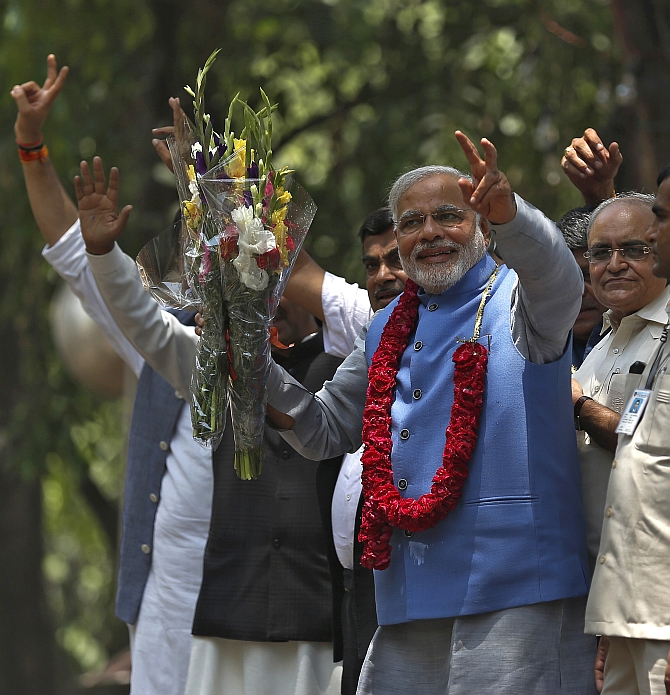
Modi govt says its economic score on all coutns is very good.

Sebi had asked all listed cos to mandatorily appoint at least one woman director.

Rediff.com gives you a look at newbies in the Council of Ministers

Gimmicks such as appointing high-profile brand ambassadors like Sachin Tendulkar will not work.
Headed by Urjit Patel, MPC for the fourth straight time kept the repo rate unchanged, at which it lends to the banks, at 6.25 per cent. The reverse repo, at which RBI borrows, will be 6 per cent.

India's economy - ranked eighth in 2015 with a GDP of $2 trillion - is projected to climb past Brazil, the United Kingdom, France, Germany and Japan and become the world's third-largest in 2030 with a GDP of $7.3 trillion.

Against a turbulent and uncertain background, Budget 2017-18 hewed a steady, forward-looking course, says Shankar Acharya, former chief economic adviser to the government.

'Given that 95 per cent of rapes are committed by adults and only 5 per cent by juveniles, these 95 per cent of rapes will continue to take place, so what women's safety are we talking about?'

Few readers will remember the socialist utopia of Indira Gandhi when food queues were the norm even for the middle class and tankers supplied water at odd hours of the night twice a week. Is that what you are trying to return us to, dear Congress, asks Jaideep Prabhu

The estimates of national income and growth do not pass the 'smell test'.
In recent past, midcap stocks have performed well, say experts.

To Indian Railways, safety is not necessarily a systemic issue but something it attends to only on a case-by-case basis. If accidents were not to happen, the thought of safety would not arise, says Mahesh Vijapurkar

'India's economy is growing faster compared to the developed economies of the world.' 'More importantly, it is growing faster compared to most of the developing economies.' 'The monsoon is not the only thing that drives the rural economy and certainly not the national economy.' 'It is too simplistic to reduce everything to the monsoon.'

Here's a round up of some information the nation learnt from Parliament on Tuesday.

'Much of the Socialism that we attribute to him actually came during Indira Gandhi's time,' says M J Akbar who believes that Nehru's convictions helped shape modern India.

The proposed changes to the child labour law to allow children and adolescents to work for their families would be most retrograde and regressive, say Shinzani Jain and Paranjoy Guha Thakurta.
